Energy Storage.
An international engineering team brought a broken compressed-air energy storage demo back to life — rebuilt, sealed, insulated and digitalized into a reliable teaching instrument. Our mission: turn a leaking, corroded prototype into a demo that clearly shows how energy can be stored as compressed air and recovered on demand.
The concept — how A-CAES works
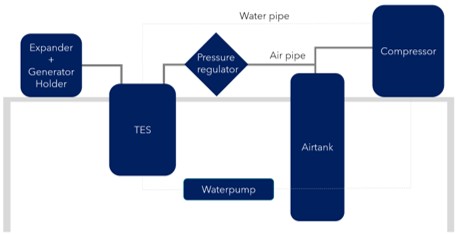
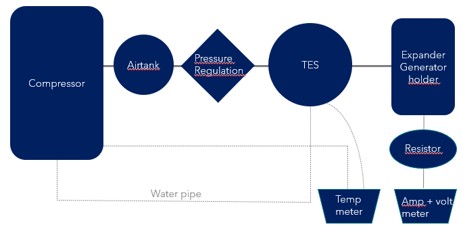
Adiabatic Compressed Air Energy Storage (A-CAES) stores energy by compressing air into a pressure tank, and releases it later by letting that air expand through a motor or turbine that drives a generator. The "adiabatic" part is the clever bit: the heat created during compression is captured and reused during expansion, instead of being wasted. The cycle runs in two phases. Charging — a compressor pumps air into the compressed-air tank (C.A.T.) and the heat generated is captured by a thermal energy storage system (TES). Discharging — the compressed air expands through an air motor or turbine, driving a generator to produce electricity, and stored heat is fed back into the air to boost output.
The starting point — the demo when we arrived
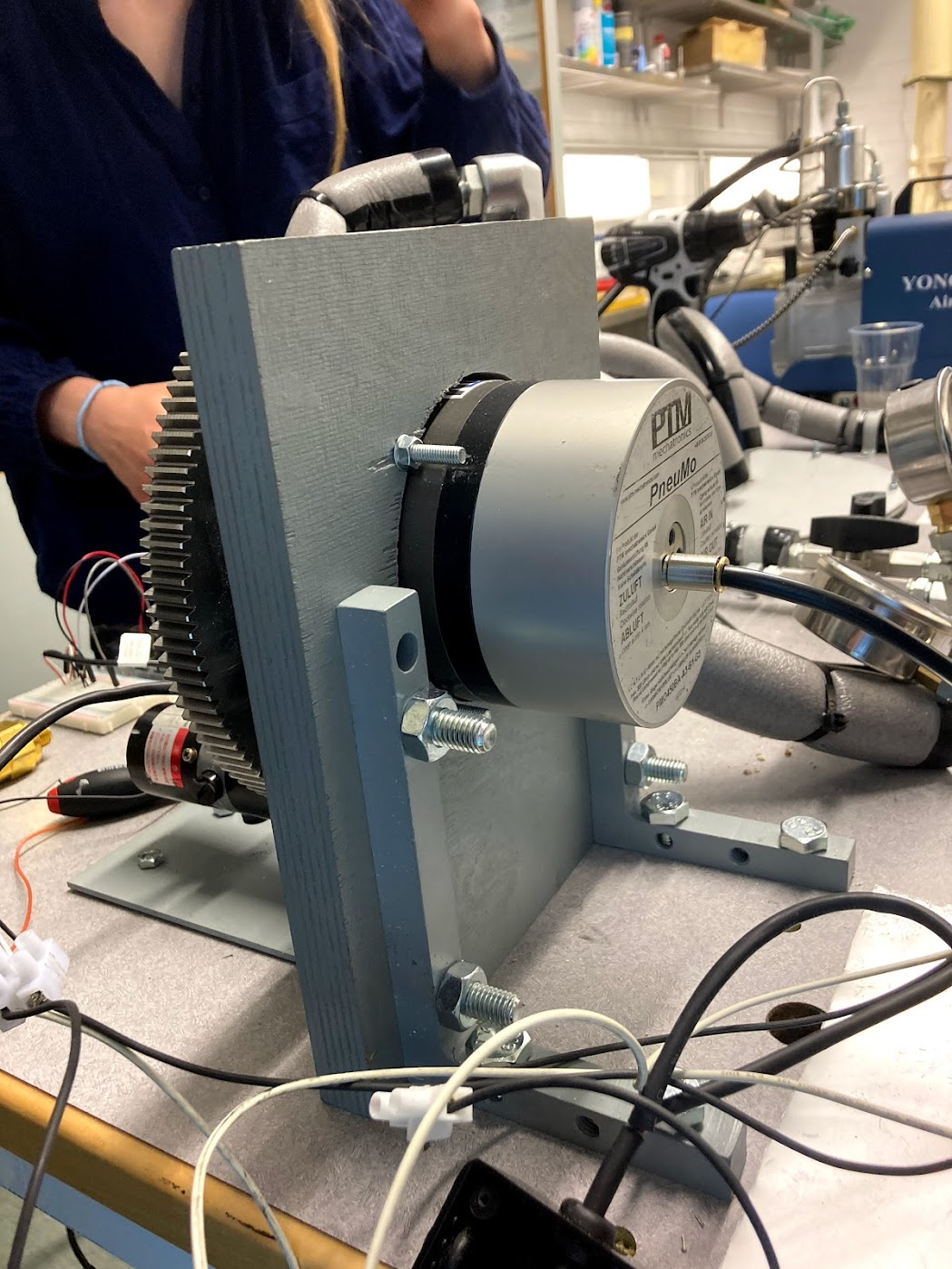
The demo we inherited from previous project groups (2019/2020) was in poor shape. Inspection revealed corrosion, multiple leaks, and components that simply couldn't hold pressure. Before we could improve anything, we had to diagnose exactly what was going wrong. Corrosion throughout the construction was compromising reliability. The compressor struggled to reach and hold the required pressure. The 3D-printed turbine had rough, jagged blade surfaces that disturbed airflow and lowered efficiency, and the gears only reached 300–1500 rpm while a working generator needs around 3000 rpm — rough gearing also caused vibration, power loss and a shorter lifespan. The pipe system was mounted above the table, so the weight of the pipes bent them out of shape; too many couplings created leaks, including a major one between the tank and the compressor, and the valves couldn't handle the pressure.
What we built — solutions
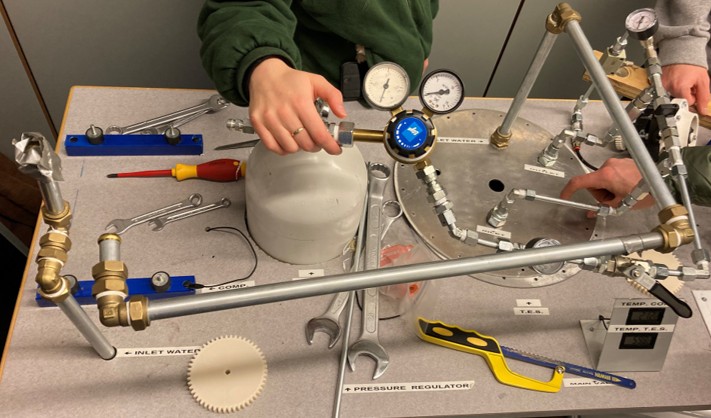
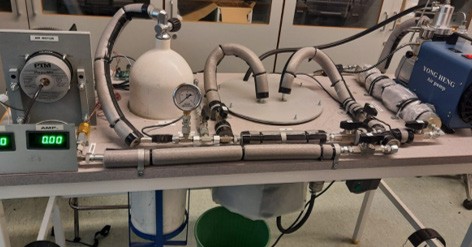
We rebuilt the demo from the ground up, focusing on reliability, efficiency and clarity. New pipe layout — we redesigned the entire pipe system with fewer, stronger connections to eliminate leaks, and repositioned the water pump for a more efficient flow. Bypass for the TES — a bypass lets the demo run charging and discharging cycles with or without thermal energy storage, so the effect of heat recovery can be measured and demonstrated directly. Rebuilt thermal energy storage — the TES was rebuilt with a new casing sealed in silicone and properly insulated to retain heat. Insulation & air filter — added insulation to reduce heat loss and an air filter to keep the system clean and dry. Efficient sensor layout — sensors were repositioned for accurate, readable measurements.
A smarter cooling idea — the water pillow
We also explored a way to put wasted compressor heat back to work: a "water pillow" (WP) concept. The water pillow connects to the water cycle so that heat flows from the pillow into the water, and from there into the air cycle. Following the gas law V = nRT/P, heating the air increases its volume — and since energy grows proportionally with expansion, more energy can be stored in the compressed-air tank. We designed the concept as a promising future upgrade, but chose not to build it within the project's timeframe, prioritizing a fully working core demo first.
Digitalization — making the demo measurable
To turn the demo into a real teaching tool, we digitalized its key measurements. Pressure and temperature sensors now capture live data during operation, letting students see exactly what happens inside the system. During discharging we measure the air motor's running time, the generator's power output (W), the end pressure of the compressed-air tank (bar) and the peak temperature of the thermal storage (°C).
Results & measurements
Operation — a demo anyone can run
A core deliverable was a clear operation procedure and user manual, so future students can run the demo safely and consistently. It walks through installing the air motor and compressor, checking each component before use, and running full charging and discharging cycles — both with and without thermal energy storage — while collecting sensor data throughout.
Safety first
The demo runs at high pressure, so safety was built into every step. Key rules include keeping the compressor pressure under 310 bar, running it only on a flat, dry surface, keeping all drain valves open at start-up, never leaving the compressor unattended while running, wearing hearing protection, and never touching the demo while it operates due to heated pipes. The system is kept in a temperature-controlled room at 22 °C.
The team
A five-person, four-country team brought together complementary engineering disciplines: Álvaro Revilla-Martín (Spain · Mechanical Engineering), Björn Graul (Germany · General Engineering), Charlotte Hargreaves (Belgium · Product Development), Milan Lemmens (Belgium · Energy Management) and Nona Van Laethem (Belgium · Product Development). Delivered as part of the European Project Semester, in partnership with Novia UAS, Vaasa UAS (VAMK) and Åbo Akademi University, at Technobothnia.